Home / Our thinking / Insights /

Table of contents
For years, enterprise technology strategy followed a familiar pattern: buy proven platforms, configure where necessary, and avoid the perceived risk of building from scratch. That model is being quietly but decisively rewritten, and with leaders under more and more pressure to grow revenues, differentiation through custom software and AI, is critical.
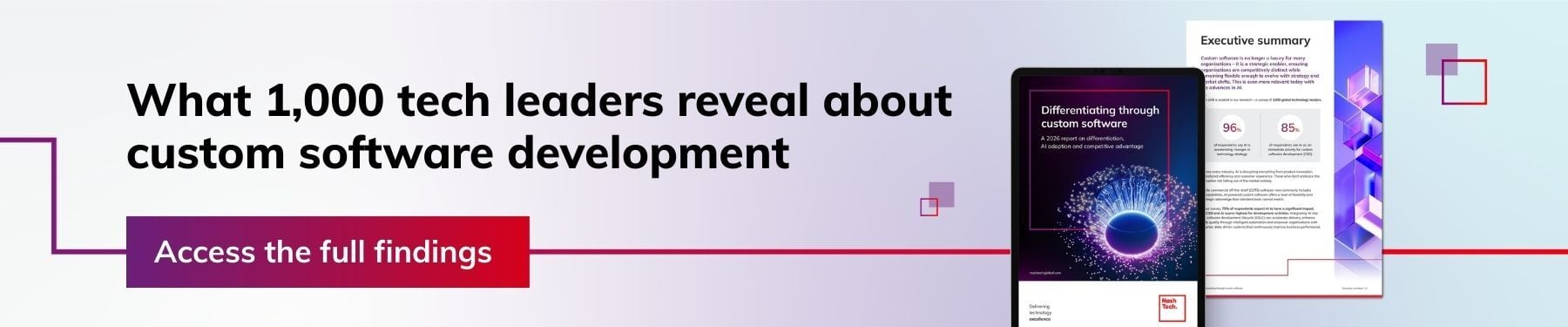
NashTech’s global study of 1,000 technology decision-makers shows just how AI is accelerating changes in technology strategy, with 85% see AI as an immediate priority in custom software development. Even more telling, 97% believe AI has made custom software more accessible than ever before. The barriers to building have fallen, but the strategic stakes have risen.
Custom software vs COTS: systems of record or systems of differentiation?
Commercial-off-the-shelf software (COTS) and software as a service (SaaS) platforms still matter. They remain effective for standard processes and systems of record. But when organisations want tighter integration, control over roadmaps, or specific customer and user experience, leaders are increasingly turning to custom software development. In fact, 70% of organisations say they would choose custom software over off-the-shelf solutions in scenarios where integration, control and experience are critical.
For CIOs and CTOs, this reframes the build versus buy conversation. The question is no longer “Can we build?” but “Where must we build to stay distinct?” Custom software has become the differentiation layer, the part of the stack where unique processes, data, and AI capabilities combine to create an advantage that truly differentiates your business.
AI in custom software development is changing the rules
AI is a major reason custom software development is climbing the agenda. Leaders expect AI to increase productivity in development, improve quality through automation, and enable smarter, continuously improving systems. In fact, 75% of technology leaders anticipate a significant positive impact from AI on custom development.
But there is a reality check. Ambition is high, yet operational readiness often lags. Integration with legacy systems is cited as the biggest challenge in custom software development, with around 40% pointing to it as their top obstacle. Legacy integration is also seen as a compliance risk by nearly half of respondents. AI, rather than masking these weaknesses, exposes them faster.
For technology leaders, this means AI-enabled custom software succeeds only when built on solid foundations, including modern integration patterns, governed data, and clear architectural ownership. Without that, organisations risk scaling fragility instead of value.
Custom software development challenges go beyond technology
Technology is no longer the primary constraint. Skills, alignment and ways of working are. Nearly all respondents express concerns about resourcing for custom software development, and a lack of internal expertise is a major barrier, especially in AI-related capabilities.
At the same time, there is a perception gap. Senior leaders often feel projects are exceeding expectations, while delivery teams report scope creep, integration workarounds and underused features. When business goals and technical implementation drift apart, ROI quietly erodes.
Successful custom software development is as much an operating model challenge as a technical one. Strong product leadership, cross-functional collaboration, and outcome-based governance matter just as much as architecture diagrams.
Governance and quality define successful custom software development
Speed still matters, but quality wins when trade-offs arise. High-quality engineering and delivery are the most compelling factors when organisations select a custom software partner. That reflects a hard lesson: rushing delivery at the expense of engineering discipline simply defers cost into rework, risk and technical debt.
Governance is also moving up the agenda, particularly as AI amplifies risk. Data privacy, third-party data handling, and legacy integration are the leading compliance concerns. Yet not all organisations apply consistent governance frameworks or board-level oversight. Leaders who treat governance as an enabler build the confidence to move faster.
What this means for CIOs and CTOs now
Custom software development is no longer a niche capability. It is a core lever for strategy. Over the next 12 months, CIOs and CTOs should look to:
- Modernise integration and data foundations before scaling AI
- Align business outcomes and delivery metrics from day one
- Invest in skills, partnerships and operating models, not just tools
- Protect quality and governance as they accelerate delivery
If your organisation is relying on generic platforms to run processes that define your business, it may be time to rethink where custom software belongs in your stack.
Download the full survey report to see how your peers are approaching custom software development, AI readiness, integration challenges and strategic partnerships, and to benchmark your own plans against 1,000 global technology leaders.
Suggested articles