Home / Our thinking / Insights /
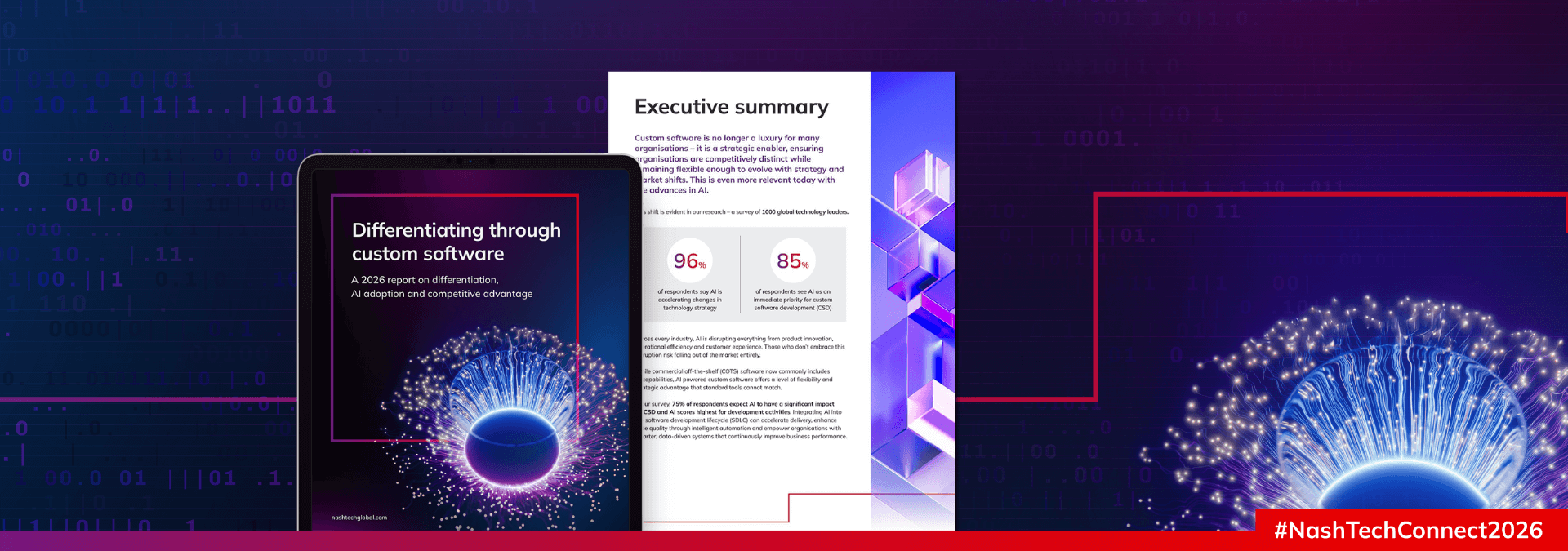
Table of contents
At the 2026 NashTech Connect Conference, NashTech’s Director of Advisory, George Lynch and Senior Technology Consultant Chris Weston took to the stage to launch the exclusive findings of NashTech’s latest insights. These insights are based on a comprehensive survey of 1,000 technology leaders, offering valuable perspectives from across the industry.
A familiar tale
The duo opened the session with a familiar story. That most organisations start with something bold and differentiating, such as a smarter pricing model, a frictionless onboarding journey, or a more intelligent claims process, only to find that the idea drifts into what George dubbed the “Enterprise Bermuda Triangle” of ERP, CRM and “the way we’ve always done it”.
The result? What should have been a competitive advantage becomes a complex customisation project bolted onto systems of record that becomes no longer distinctive.
Testing the story with a comprehensive survey
To test whether this story was universal, NashTech commissioned independent research through Vanson Bourne, surveying 1,000 technology decision-makers across six territories, spanning enterprises and independent software vendors.
The hypothesis was simple: custom software is easier to create and manage than ever before and it is increasingly where true differentiation lives.
When launching the findings, George put three clear stakes in the ground:
- Modern engineering makes custom software the differentiation layer
- Commercial off-the-shelf (COTS) and Software as a Service (SaaS) still matter
- AI will fundamentally reshape how both are built and managed
- Integration becoming strategic infrastructure
- Partnerships becoming outcome-driven
- Build versus buy dynamics reshaped by AI
- Quality and governance outpacing speed-at-all-costs
The room was relieved to hear that this was not an argument to rip out core platforms. Quite the opposite. The message was to standardise the core, especially infrastructure and data, and then innovate and differentiate at the edges.
Integration is the new strategic infrastructure
If custom software is the differentiation layer, integration is the foundation beneath it.
One of the biggest shifts discussed was the idea that integration is no longer plumbing. It is a strategic infrastructure. As AI becomes embedded into workflows, ingesting and generating information at scale, the quality of integration will determine whether organisations can move quickly or get stuck.
As Chris pointed out, there’s also a looming question: will regulators begin treating integration quality as a compliance issue? As governance around AI tightens globally, that feels less like a hypothetical and more like an inevitability.
Technical debt, long tolerated in many enterprises, is now directly affecting business outcomes. Legacy integrations, security vulnerabilities and performance constraints are no longer background noise. In an AI world, they become blockers.
Governance: from brake to accelerator
NashTech’s research revealed strong intent around AI governance, with many organisations planning significant steps in the coming year. But fewer have robust, board-level frameworks in place. That gap creates the risk of ‘governance theatre’, processes that look impressive but lack real accountability.
George reassured the audience that when governance is treated as an enabler rather than a brake, velocity improves. Teams ship faster because guardrails are built in, code is safer because compliance is proactive, and trust increases across the organisation.
Build vs buy in the age of AI
Perhaps the most energising part of the discussion centred on build versus buy.
As AI tooling improves, small, focused teams can now achieve what once required large engineering departments. Domain-specific models may outperform large foundation models in targeted use cases. Custom data exploitation could outpace generic capabilities from COTS vendors.
George reiterated throughout the session, “Standardise the core. Build where differentiation matters. Partner strategically. And design contracts around outcomes rather than effort.”
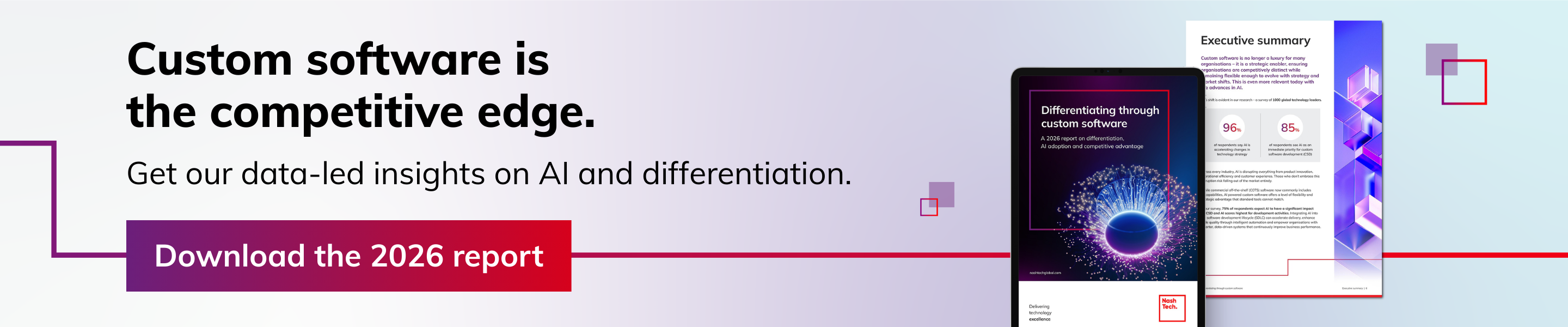
George and Chris continued to walk the audience through some of the key findings from the report and what this means for technology leaders. Download your copy of the report, here.
So, what should leaders be watching?
Based on NashTech’s independent research, Chris outlined four major themes that will shape the next 12 to 24 months.
Not all of these shifts will materialise at once. But leaders need to be thinking about what happens if they do. How ready is your data foundation? How embedded is governance in your development lifecycle? Where does differentiation truly live in your stack?
If this session made one thing clear, it’s that competitive advantage in the AI era will not come from adding ‘just one more module’. It will come from deliberate architecture, disciplined governance and the confidence to build where it counts.
To explore the research insights and strategic implications in full, download your copy of the report
Suggested articles