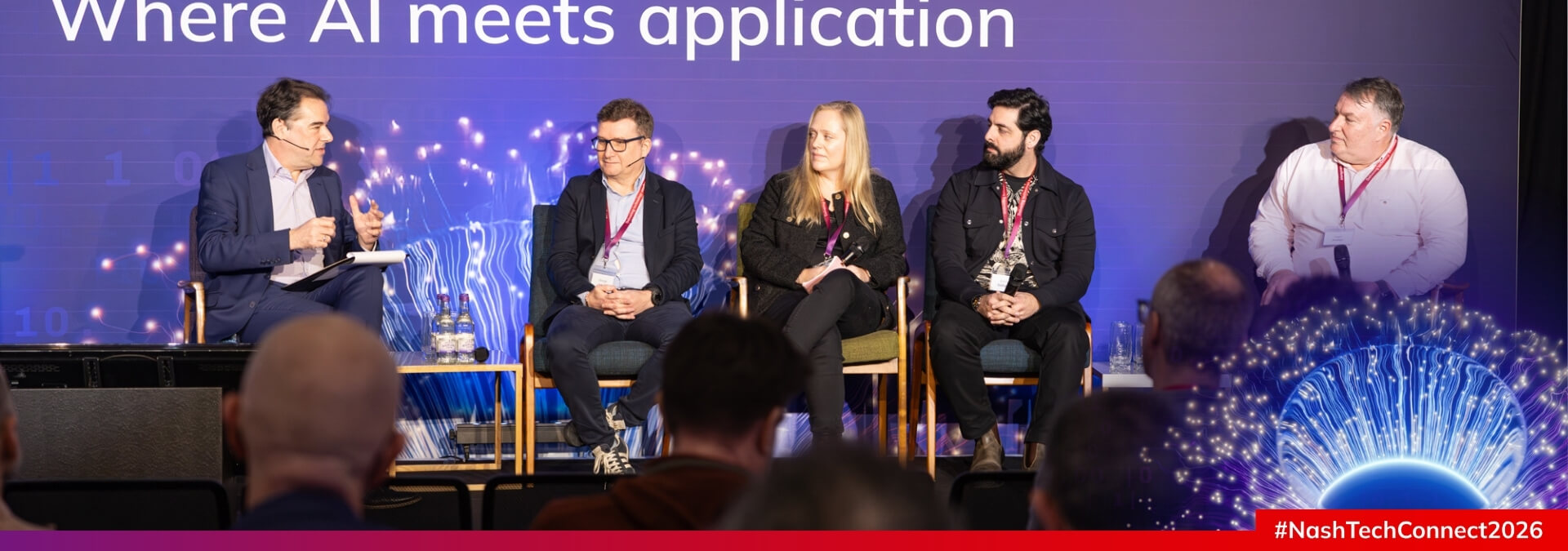
Moderator: Bryan Glick, EditorinChief, Computer Weekly
Panellists: George Lynch (Director of Advisory, NashTech), Nigel Phillips (CEO, CDL Software), Michelle Ripley (IT Director, Third Space), Azhar Sadique (Global Head of AI Enablement, Abion and Chairman of CITMA)
The panel at NashTech Connect 2026 brought together leaders who each sit at a different vantage point of the digital transformation landscape. What followed was a candid discussion about readiness, risk, and the realities of adopting AI and emerging technologies at scale.
Bryan Glick opened with a deceptively simple question: “Are organisations truly ready for the pace of change they claim to be embracing?” The responses revealed a tension between ambition and capability that shaped the entire conversation.
The readiness gap: ambition without foundations
George Lynch was the first to call out the elephant in the room: many organisations are aspirationally digital but not structurally prepared. He emphasised that technology is rarely the blocker; culture, governance, and clarity of purpose are. “Most companies want transformation, but very few have the operating model to sustain it.”
Nigel Phillips built on this, noting that software companies are feeling the same pressure. “Customers want AI-powered everything, but they don’t always know what problem they want solved.”
The panel agreed that the gap between expectation and execution is widening, and that leaders must confront uncomfortable truths about their own maturity.
AI: hype, hope, and hard questions
Azhar Sadique brought a pragmatic lens to the AI conversation. As someone responsible for global AI enablement, he stressed that the challenge is not model capability, it’s organisational discipline. “AI isn’t magic. It’s maths, data, and governance. If you don’t have those, you don’t have AI, you have risk.” He argued that the next wave of AI adoption will be defined not by experimentation but by responsible scaling, where ethics, IP protection, and regulatory alignment become competitive differentiators.
Michelle Ripley added a real-world operational perspective from the consumer fitness sector: “AI only works when it enhances the human experience, not replaces it. Our members don’t want automation, they want personalisation.” Her point underscored a recurring theme: AI must be human-centred to be valuable.
Data: the fuel, the friction, and the future
Data quality and accessibility emerged as a central tension. Lynch shared that organisations often underestimate the effort required to make data usable: “Everyone wants AI, but no one wants to clean the data.”
Phillips echoed this from a product standpoint, explaining that legacy systems and fragmented data architectures remain the biggest barriers to innovation. Sadique added, “If your data is chaotic, your AI will be chaotic. There’s no shortcut.”
The panel agreed that data strategy is no longer a technical concern; it is a board-level responsibility.
Talent and culture: the human side of transformation
Michelle Ripley spoke keenly about the cultural implications of rapid technological change. “People don’t fear technology; they fear being left behind by it.” She argued that organisations must invest as much in capabilitybuilding as they do in technology procurement. Upskilling, psychological safety, and transparent communication are now essential components of transformation.
Phillips added that attracting and retaining talent increasingly depends on whether organisations can offer meaningful, modern engineering environments.
Trust, regulation, and the new social contract
As AI becomes embedded in everyday operations, trust surfaced as a defining issue. Sadique, drawing on his role at CITMA, warned that regulation is coming faster than many organisations expect: “Compliance won’t be optional. If you can’t explain your AI, you won’t be allowed to deploy it.”
Glick pushed the panel on whether regulation will slow innovation. Lynch responded with a nuanced view: “Good regulation doesn’t slow innovation, it stabilises it. It gives the market confidence.”
Closing remarks: transformation is no longer about technology
In his closing remarks, Glick asked each panellist for one piece of advice for leaders navigating the next wave of digital change. Their answers converged on a single truth:
- Start with clarity, not technology
- Invest in people before platforms
- Treat data as a strategic asset, not an afterthought
- Adopt AI with responsibility, not recklessness
The overarching message was that digital transformation is not about adopting new tools; it’s about redesigning how organisations think, operate, and create value.
The panel left the audience with a final thought: technology is accelerating. The question is whether leadership, culture, and governance can keep up.
If you’re ready to take your organisation’s next step in digital transformation and want expert guidance tailored to your needs, connect with NashTech today. Our team is here to support you in navigating the evolving landscape with confidence, clarity, and responsibility.