Home / Our thinking / Insights /

Table of contents
As generative AI and agentic technologies rapidly reshape the software development landscape, organisations are under pressure to move beyond experimentation and into true, scalable adoption.
At NashTech Connect 2026, NashTech’s Phill Went, Global Transformation Director and Leon Doherty, Head of Client Onboarding, delivered a compelling session that confronted this challenge head-on. Their presentation blended hard data, lived experience, and two years of continuous iteration across client engagements, offering a realistic, actionable blueprint for how AI can be embedded across the software development lifecycle (SDLC).
Their message was both reassuring and energising: while many organisations feel stuck in pilots, meaningful AI-driven transformation is absolutely achievable with the right foundations in place. And NashTech’s own AI journey proves it.
The reality check: AI is a priority, but scaling remains difficult
Phil opened with an observation that captured the emotional state of most organisations today. There is excitement about AI’s potential and a genuine desire to harness it, but also an undercurrent of trepidation. Teams worry about skills gaps, data protection, compliance, and the fear of ‘getting it wrong’. This duality came through clearly in NashTech’s CSD survey results, which Phil unpacked in detail.
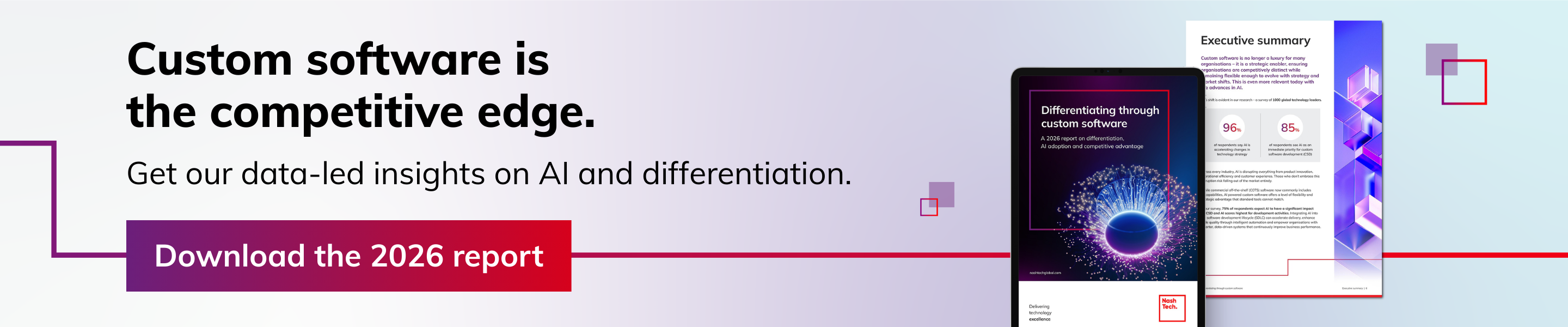
Nearly every organisation surveyed said AI is accelerating their technology strategy, and 85% now view AI adoption across the SDLC as an immediate priority. Three-quarters expect AI to have a significant impact on delivery. Yet despite this enthusiasm, almost half of the respondents said they are struggling to balance the speed that AI promises with the need to maintain quality.
More revealing still were the barriers preventing scale. 43% of organisations lack the internal skills needed to make meaningful progress, while 35% cannot access those skills externally. Compliance, IP protection, and data security remain deeply embedded concerns, ones that cannot simply be abstracted away by technology.
Phil summarised the situation with characteristic understatement: “Given our experience, it does make me wonder what the other 25% are assuming.”
The message was clear: the intention to adopt AI is universal, but the capability to scale it remains uneven. And this is what leads many organisations into what Phil calls the pilot trap, the pattern of experimenting without ever progressing to embedded, repeatable, organisation-wide practice.
Breaking the pilot trap: NashTech’s multi-year AI journey
Leon continued the session by walking the audience through NashTech’s own AI adoption journey, a multi-phase path that provides a realistic model for other organisations looking to scale.
NashTech began early, running structured pilots in 2024 with five clients and roughly 40 engineers. Importantly, the team approached these pilots scientifically, establishing beforeandafter baselines and controlling variables wherever possible. Tools such as GitHub Copilot, early agent assistants, and prompt-driven workflows formed the backbone of these experiments.
Even in their earliest form, the tools generated meaningful uplift. Teams saw around 10% productivity improvement, particularly in greenfield development, along with measurable quality gains across code reviews, defect density, and Sonar metrics. Developers reported improved job satisfaction, a recurring theme throughout the journey.
But the biggest transformation came in 2025, when NashTech introduced more advanced agentic and MCP-enabled tools. These tools were no longer limited to generating code; they could support testers, business analysts, and cross-functional teams. The effect was striking: productivity gains increased to an average of 30% across agile squads, and brownfield development, traditionally slower and more complex, saw significantly stronger outcomes than in the early pilots.
Importantly, the organisation invested heavily in capability building. More than 1,000 employees undertook AI literacy training, with over 90% completing it across development, testing, and BA roles. Governance frameworks, security safeguards, and bestpractice communities of practice ensured adoption was responsible, ethical, and sustainable.
Leon’s emphasis throughout was clear: AI amplifies human capability, but it does not replace human accountability. As he put it: “The tool supports the human, but the human is accountable. You never blame the tool.”
Rethinking the SDLC: humanintheloop, reimagined
Phil then shifted the conversation to the implications of AI on traditional delivery models. With innerloop activities (such as coding, testing, or analysis) now accelerated from hours to minutes, it no longer makes sense for humans to intervene at every step. Instead, the focus shifts to validating complete outputs, reviewing outcomes, and ensuring correctness at decision points that matter.
This shift naturally pushes teams towards kanban-style continuous flow, reducing the need for strict sprint cadences and manual checkpoints. As agentic AI evolves toward orchestration, where multiple agents collaborate, share memory, and coordinate tasks, these efficiencies will only compound.
In Phil’s words: “Given the speed of implementation, why review every interim step? Validate the outputs at the end of the cycle.”
This framing acknowledges a critical truth: AI doesn’t remove the need for humans. It changes where humans contribute value.
The outcomes: what scaled AI looked like for NashTech
Across two years, NashTech has achieved a measurable improvement in productivity, quality, and organisational capability. The results include:
- 40% AI adoption across the client base
- 30% average productivity increase across agile squads
- 20% reduction in bugs and defects
- Strong, consistent quality improvements across engineering metrics
- Tangible cultural shifts, with scepticism giving way to confidence
Some of the strongest endorsements came directly from the engineering teams:
“AI doesn’t replace me; it helps me do the work I really want to do.”
“I was worried at first, but now I can’t work without it.”
A human-centric future for AI in software delivery
The session closed with a powerful analogy from a recent AI event focused on healthcare. AI is transforming cardiology by improving diagnostic accuracy and speeding up decision-making, but it is not replacing cardiologists. Instead, it enables them to focus on highervalue, human-centred work.
The same applies to software delivery.
AI accelerates tasks, enhances quality, and allows teams to focus on creativity, judgment, and value creation. But scaling AI responsibly requires training, governance, measurement, and, above all, a commitment to keeping humans at the centre of the process.
Phil and Leon’s presentation demonstrated that with the right foundations, AI at scale is not only possible, it is also already delivering extraordinary impact at NashTech.
To download your copy of NashTech’s Differentiating through custom software, click here
Suggested articles