Home / Our thinking / Insights /

Table of contents
As generative and agentic AI continue to move from experimentation to enterprise reality, organisations face a critical inflection point. Many have successfully deployed pilots, tools, and proofs of concept, but fewer have paused to ask what happens when AI becomes foundational rather than incremental.
At NashTech Connect 2026, George Lynch and Thomas Pointer tackled this question head-on in a thought-provoking session on AI maximalism. Their presentation challenged familiar assumptions about enterprise technology, arguing that AI is no longer something organisations add to existing stacks, but something that increasingly redefines them.
From stacks we know to stacks that are emerging
George Lynch, Director of NashTech Advisory, opened the session by anchoring AI maximalism in the findings of the NashTech report launched earlier in the day. That report set out a clear position: custom software remains a differentiator, commercial off-the-shelf solutions still matter, and AI is fundamentally changing how technology is built and operated.

Building on this, George contrasted two models.
The first is the traditional enterprise technology stack, one that most organisations recognise:
- Systems of record at the core
- Applications layered on top
- Integration acts as the glue
- Governance is often applied after delivery
The second is not a finished future state, but a direction of travel already influencing real decisions. In this emerging AI native model, George argued, the centre of gravity shifts; “value moves away from applications and screens and concentrates around trusted data, models, organisations’ control and the ability to orchestrate work.”
The change is subtle but profound. Technology becomes less about running software and more about coordinating decisions, actions, and outcomes.
What AI maximalism really means
George was careful to define AI maximalism by what it is not. It is not hype. It is not “AI everywhere” as a slogan. And it is not a call to rip and replace systems overnight.
Instead, AI maximalism is a posture, a recognition that once AI becomes dependable enough to reason and act autonomously, it stops being a feature and becomes structural.
In this world:
- Applications matter less than flows of work
- Screens matter less than decisions
- Technology stacks increasingly organise around data, models, agents and policy, rather than menus, modules and interfaces
Crucially, AI maximalism is not a destination. It is what naturally happens when AI becomes too important to sit at the edges of enterprise architecture.
Why incremental AI adoption starts to strain
Drawing on NashTech’s research, George highlighted a growing tension inside many organisations. AI ambition is high, and adoption is accelerating, but foundations such as integration, governance and operating models are already under pressure.
Incremental AI adoption, he argued, doesn’t fail because it is wrong. It often fails because it becomes internally inconsistent once AI begins to shape how work itself is executed. At that point, bolting AI onto existing structures creates friction rather than leverage.
This is the moment where organisations must choose whether to keep patching legacy assumptions or rethink the stack itself.
Al native architectures and the governance gap
George described AI maximalism as a broader paradigm shift. In AI native architectures:
- Generative and agentic AI move to the core
- Models and agents orchestrate processes across data, applications, and infrastructure
- Capabilities such as MLOps and AgentOps become foundational
- Security, risk and AI governance are embedded by design
He also highlighted a gap revealed by the survey data. While executive leaders express optimism, many mid-level leaders continue to struggle with integration, scope control and value realisation. Closing this gap requires embedding governance and benefits tracking directly into delivery frameworks, not treating them as an afterthought.
What this means for enterprise and SaaS leaders
For enterprise CIOs, George outlined a shift away from isolated pilots toward fully integrated AI-native stacks. Priorities include robust data foundations, clear model strategies, modernising legacy systems using agent-based workflows and introducing new operating roles such as AI product owners and agent reliability engineers.
For SaaS providers, the implications are equally stark. Survival in an AI maximalist world depends on evolving from feature-centric platforms to AI-native ecosystems, enabling customers to bring their own context, embedding trust by design and rethinking commercial models around usage and outcomes rather than licences alone.
Extending the vision
Where George framed the architectural shift, Thomas Pointer, Senior AI Consultant at NashTech, explored what AI maximalism could mean in practice, particularly for how people interact with digital services and information.
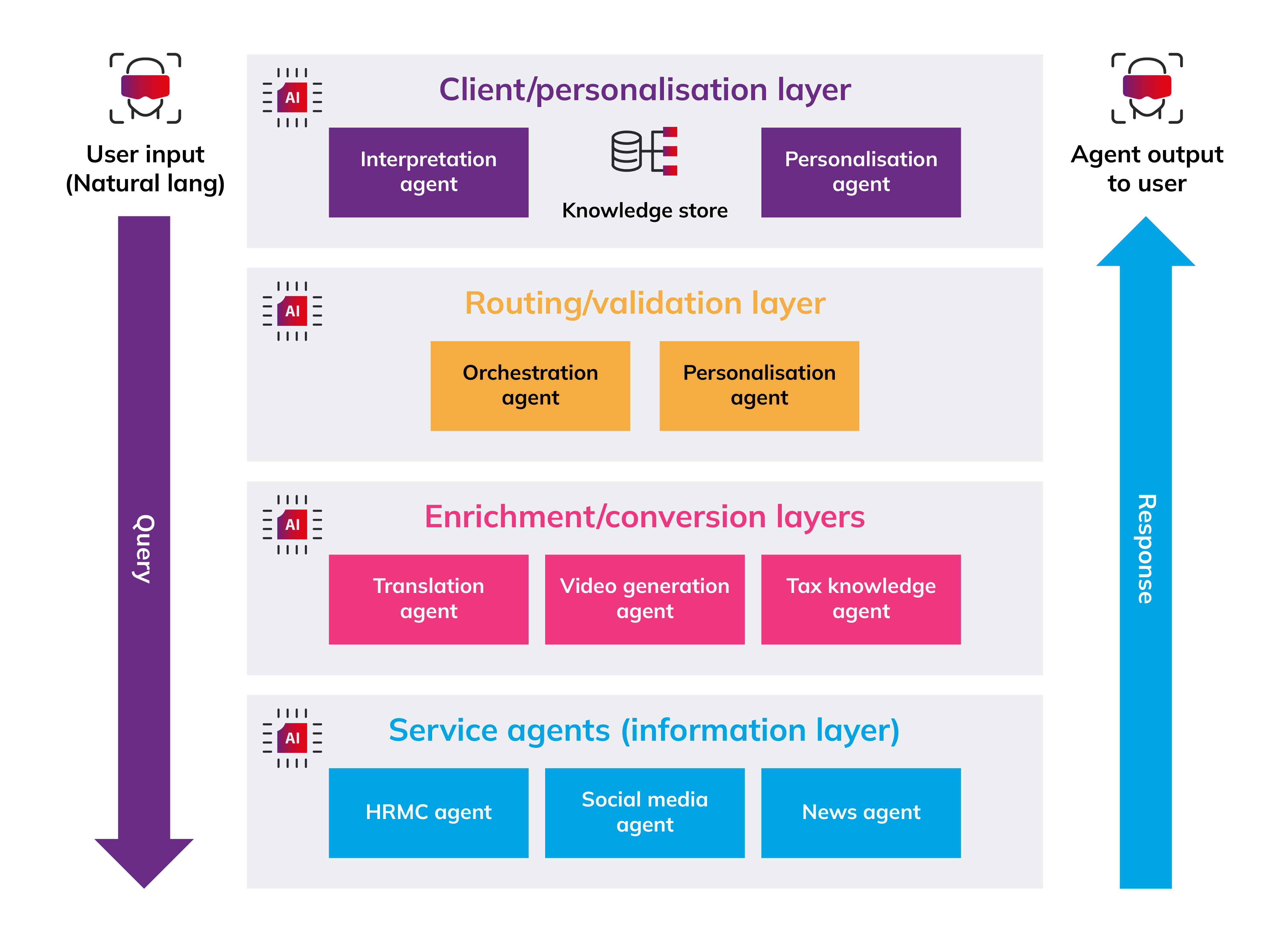
Thomas described a future where the internet is accessed primarily through natural language, mediated by intelligent agents rather than apps, URLs or search engines. In this model:
- A single client agent becomes the user’s interface to information
- Personal context, preferences and accessibility needs are built in
- Networks of specialised agents collaborate to fulfil complex requests
- Information is validated, enriched, translated and delivered in the user’s preferred format
Using a public sector example, Thomas illustrated how language barriers, fragmented systems and complex journeys could be replaced by orchestrated agent interactions, making services more accessible, explainable and responsive.
From vision to direction of travel
Thomas acknowledged the practical constraints that still exist, from compute costs to the need for agent discovery and wider adoption of agent-enabled services. But his conclusion aligned closely with George’s framing: the building blocks of AI maximalism already exist. What is changing is how centrally they are positioned in the technology landscape.
Together, George and Thomas presented AI maximalism not as speculation, but as a credible direction of travel, one that challenges long-held assumptions about software, architecture and the role of AI in enterprise technology.

Suggested articles