
Home / Our thinking / Insights /

Table of contents
AI and Generative AI (GenAI) have shaken up the education sector. University staff are using it to draft course pages, students are leaning on it for explanations, and professional services teams are testing it out for student queries, automated workflows and gaining efficiencies.
Universities worldwide often ask us about GenAI strategies, with many wondering - How can we implement safe GenAI strategies that deliver measurable impact on teaching and learning?
If you’re asking yourself that same question, let’s unpack some of the advice we provide. This article is designed to give you pragmatic thinking to help you implement GenAI safely.
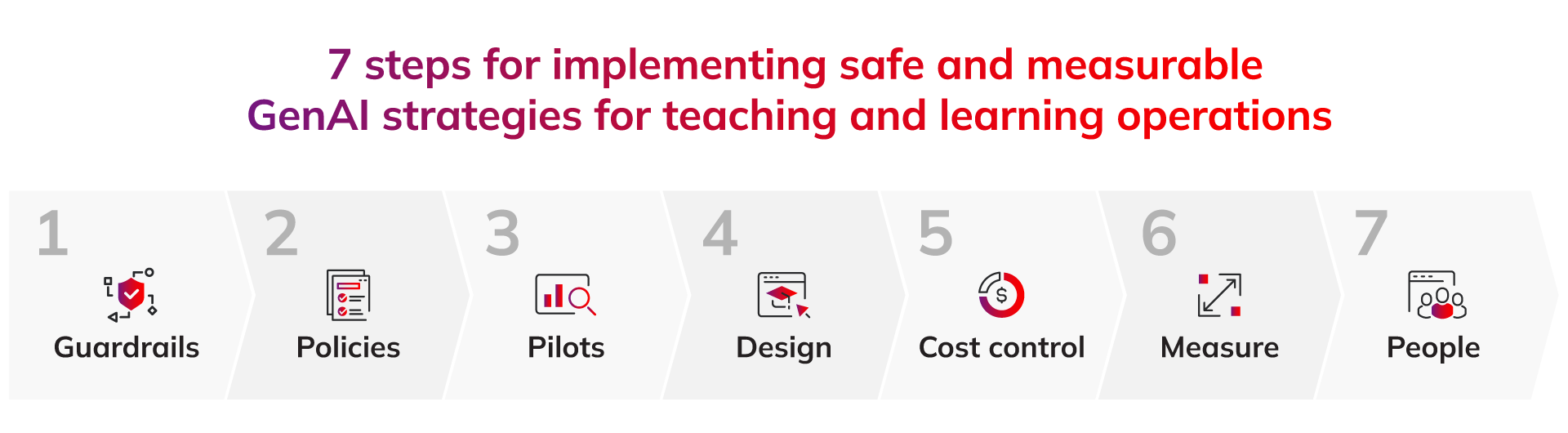 Guardrails
The opportunity space created by generative AI is virtually infinite, and its potential is enormous. Your readiness for GenAI hinges on several factors, including having a clear understanding of the outcome you’re looking to achieve, knowing the processes you are targeting, having the right skills and people to execute your plans, and of course, the right approach to data. But it’s sometimes easy to forget another important important factor - the clarity of your guardrails.
As a technology leader, you need to set guardrails that are clear and ruthlessly practical. Here’s a good start:
- Define where GenAI can play and where it absolutely cannot, anchored in your risk appetite and existing data governance.
- Define the output required, using specific data sources that get the right results. Exclude all other sources – it’s either the right result, or no result.
- Lock down sensitive data with role-based access and prompt security controls.
- Establish a human-in-the-loop process, particularly for any decisions that affect students, staff, money, or compliance.
- Mandate prompt and output logging for auditability. Track as much as you can as you are responsible for its outputs. You need to understand how and why AI did what it did, and be able to explain it if asked. As Dan Henry, Strategic Account CTO for Insurance and Investments at Microsoft, says, “human-in-the-loop isn’t a compliance checkbox; it’s a philosophical stance about accountability. When things hallucinate, you are the person using that tool… You are still responsible.”
- Run regular stress-testing to catch bias and hallucinations early. How easily can your university’s chatbot be tricked into revealing restricted information? Or how often are your tools providing wrong answers? Uncover its weaknesses so you can fix them before they cause real-world damage.
- Standardise approved tools to deter well-meaning (but less aware) employees from experimenting with GenAI tools without approval.
- Tie every use case to a measurable outcome and appoint project owners to document the problem statements, objectives, workflow (human vs AI), and establish how to track performance.
Policies
Early wins often come from carefully scoped pilots, underpinned by practical policies. You need to write short and clear policies that are championed by both your Academic Quality team and IT teams. As an example, your first policy could cover:
- Permitted uses: e.g. idea generation, summarisation, and knowledge search are all fine, but it is prohibited for unsupervised grading or high-stakes decisions.
- Data boundaries: what staff and students can/can’t paste into prompts; how personal data and research data are handled under GDPR.
- Attribution and academic integrity: expectations for disclosure, citation, and assessment design that reduce over-reliance.
- Model selection standards: approved providers, privacy posture, auditability, UK data residency options, and content provenance support.
- Human-in-the-loop: where human review is mandatory (marking, welfare, admissions).
Pilots
With so many potential use cases for GenAI at your university, it's important to start sensibly. Our advice is to focus on improving student experience or staff productivity for quick wins that don't require major structural changes. Here’s a selection of good pilots you might want to explore:
- Student services copilot: natural-language Q&A over policies, timetables and FAQs; which may hand off to a human for edge cases.
- Learning content drafting: help module teams create course overviews, rubrics and announcements faster, with accessibility baked in.
- Knowledge search for staff: retrieval over policy, HR and procurement docs to reduce email ping-pong.
- Marking support (HITL): rubric suggestions, draft feedback and tone checks; but never final grades without human review.
- Research admin helper: boilerplates, forms, applications for research grants and data management plans.
Design
GenAI shines when it’s built into the very design of learning, not just bolted on. Here are some of the quick wins we’re seeing being built into teaching and learning:
Assessment redesign: Could you use AI to change how you test and assess learning? Less “repeat the facts”, more “spot mistakes, explain your thinking, and use what you know”. You might also shift the weight towards making something practical, like a short video or mini project, instead of just a quiz.Transparency for students: When AI is used to produce feedback or draft text, be honest and say so; and encourage students to declare AI support in submissions.
Accessibility and inclusion: Make learning fairer for everyone by using AI to give quick summaries, create different formats (audio, bigger text), and provide additional language help. Just keep an eye out for any bias or AI drift.
Digital literacy: Teach safe, smart use in short lessons for everyone (teachers and students) on how to use AI responsibly. Do it right at the start of the term so good habits stick.
Cost control
A ‘brilliant idea’ or pilot that drains your funding is likely to do more than raise a few eyebrows, so from day one, you need to track costs forensically. Here are some of the things to think about when tracking the costs of GenAI:
- Route requests to the smallest model that meets your need, reserving the bigger, more costly models for the harder tasks. Use retrieval-augmented generation (RAG) so you can downshift model size while maintaining accuracy.
- Use efficient prompts to streamline outputs rather than asking for costly essays. Template prompts and version control repeat enquiries to reuse answers you’ve already paid for, to avoid paying twice. e.g. FAQs, course handbooks and policy text.
- Implement a chargeback budget per faculty, project, and grant; tag everything so you can clearly see who’s spending what. You could also build in budget approvals for high-cost models and fine-tuning jobs.
- Mix commercial, paid-for APIs with open-source models where viable; compare total cost of ownership, including egress, security, and compliance.
- Plan for seasonal spikes (start of term, exam periods, etc.), and if possible, negotiate pricing and burst credits.
- Use GenAI efficiently. Right-size infrastructure: batch non-urgent jobs, schedule overnight, use autoscaling and monitor GPU/CPU utilisation, embedding rates, vector DB reads/writes—these often dwarf inference in steady state.
- Keep data local when possible to cut latency and egress; deduplicate corpora before indexing.
Measure
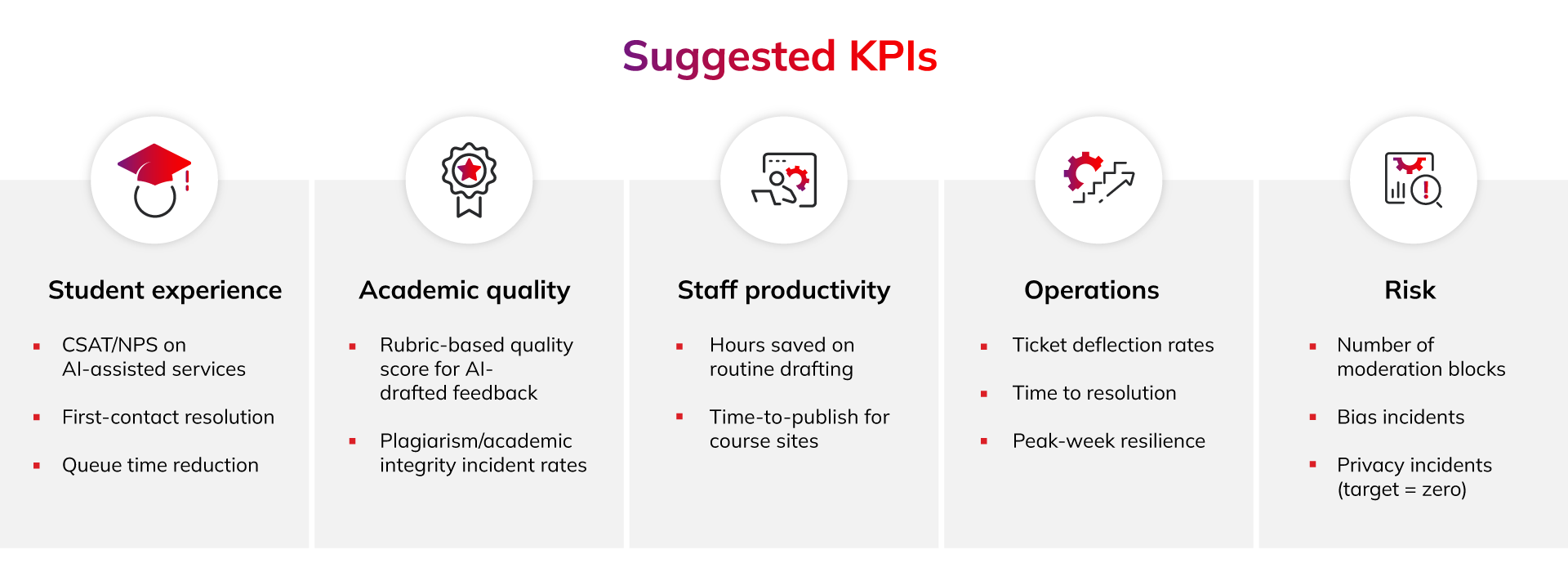
Set success metrics before the launch of your new GenAI initiative and report on them as you would any other transformation.
 People
You don’t need a cast of thousands to properly implement your GenAI strategies safely, but you do need clear roles:
- Product owner (academic or professional services) to champion use cases.
- AI engineer/solutions architect to handle RAG, orchestration and observability.
- Data protection and legal to sign off boundaries.
- Learning design to integrate into pedagogy.
- Change and communications leader so staff know what’s changing and where to get help.
- Training lead to offer micro-upskilling in prompt patterns, data handling dos/don’ts, and “how to escalate to a human”.
GenAI in universities shouldn’t be a leap of faith. It should be a careful step onto solid ground. It should be well governed, measurable, reversible when needed and genuinely helpful for staff and students.
If you want a second pair of eyes on your roadmap, we can help.
NashTech can also help you:
- Create cohesive architectures that scale globally: identity, data and integrations that join LMS, SIS, CRM and knowledge stores without the sprawl.
- Build custom where it counts: task-specific copilots tied into your workflows (not another tab to ignore).
- Create AI with guardrails: RAG patterns, governance and observability that pass internal scrutiny and deliver measurable wins.
For more details, visit www.nashtechglobal.com/software-solutions/artificial-intelligence/ or get in touch with us at www.nashtechglobal.com/contact-us/
Suggested articles


.jpg)